
What is actually happening in green hiring?
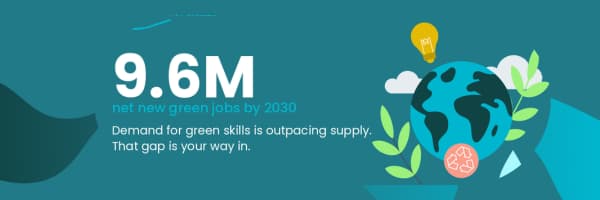
If you have wondered whether a climate-focused career is a safe bet, the numbers are doing the reassuring for you. The World Economic Forum estimates the green transition could add a net 9.6 million jobs globally by 2030, even after the roles that disappear in carbon-heavy industries are counted (World Economic Forum, Nov 14, 2025). The catch, and the opportunity, is that demand for people with 'Green skills' is outpacing the supply of people who have them.
In a January 2026 analysis drawing on more than 11,000 executives across 126 countries, WEF mapped how the transition reshapes labour markets very differently depending on where you are (World Economic Forum, Jan 15, 2026). Some economies expect strong growth but worry they cannot find enough skilled workers to capture it. Others face disruption and will lean hard on reskilling. Across every scenario, one theme repeats: the people who can move into new green roles, or who bring scarce green skills, hold the advantage.
Why do green jobs matter for your impact career right now?
That demand sits inside a wider labour market that looks stable on the surface but is uneven underneath. The ILO's Employment and Social Trends 2026 projects global unemployment holding around 4.9%, while the broader jobs gap reaches 408 million and progress on job quality stalls (International Labour Organization, January 2026). In plain terms: generic roles are crowded, but roles tied to clear, growing needs are where the momentum is, and green is squarely one of them. Green is also not a single job, and not only for engineers. WEF points to fast-growing demand in renewable energy, environmental engineering, and clean transport, but the same shift pulls in project managers, data analysts, policy specialists, community organizers, and finance professionals who can speak the language of sustainability. If you already hold a transferable skill, the green economy may need it sooner than you expect.
Where are the green jobs growing?
The geography is shifting too. The transition is creating openings well beyond the traditional capitals, and emerging regional hubs are increasingly where mission-driven hiring happens. Being open on location widens your options considerably, and it puts you closer to where new green activity is being built.