
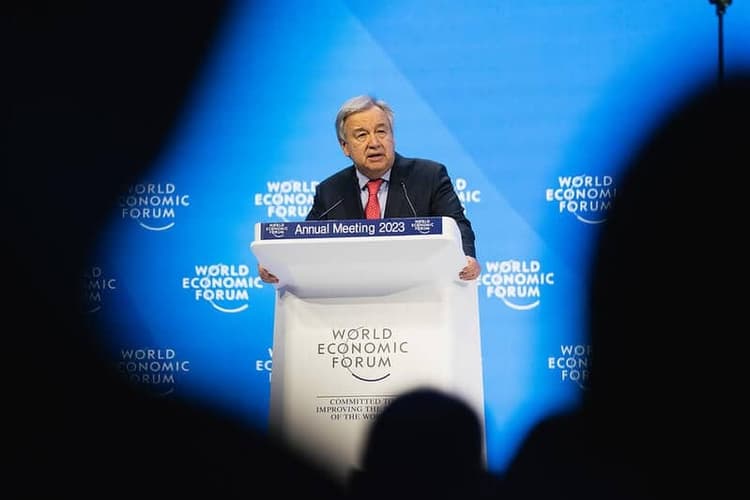
Although Davos is the location for the annual World Economic Forum meeting, most people also refer to the meeting itself simply as Davos. Davos takes place in January, with business and world leaders gathering to solve the biggest issues facing our world. Climate change has been a constant theme as has inclusion, diversity and how economies can be developed to meet the needs of everyone.
This year for discussions on the 2023 theme of "cooperation in a fragmented world" From energy to food to humanitarian relief, where are the concrete opportunities for progress on urgent global challenges despite the strong tides of geopolitical and geo-economic fragmentation. This year's event is taking place from January 16-20.
The World Economic Forum releases the Global Risks Report ahead of the Annual Meeting each January, to identify and analyse the upcoming near- and longer-term critical global risks that underpin discussions.
Who comes to Davos and who engages?
There will be plenty of business leaders at Davos – people who make big decisions that can affect everyone.
But that's not the whole story. Approximately one-third of participants are from civil society – including groups that campaign about poverty and inequality, the environment and human rights – as well as academia and the media.
The global public can watch and engage with the Annual Meeting through livestreamed sessions, social media and virtual connections to Forum hubs, centres and projects around the world.
Participation in the Annual Meeting at Davos is by invitation to the following Forum communities:
-
Chief executives and chairs of the Forum 1,000 Partner companiesactively engaged in initiatives and communities such as the International Business Council, Community of Chairpersons and Industry Governors.
-
Public figures from across the world including G7 and G20 countries, as well as heads of international organizations.
-
Leaders from the foremost civil society, labour and media organizations as well as top thinkers and academics.
-
Members of the Global Innovators and Technology Pioneers community, the Community of Global Shapers, the Forum of Young Global Leaders and the Schwab Foundation for Social Entrepreneurship.
You can see much of the action live as it happens, with over 150 sessions available to watch online and a dedicated website liveblogging highlights.
Why is Davos Important?
The 'Davos Manifesto', created in 1973 and renewed in 2020, lays out the principles of stakeholder capitalism - or a system of shared goals for businesses - such as those outlined in the United Nations Sustainable Development Agenda.
The World Economic Forum declares in its mission statement, "We believe that progress happens by bringing together people from all walks of life who have the drive and the influence to make positive change." Davos is an opportunity for thousands of voices and perspectives to come together to dissect how progress can actually be made every year. Davos is also an opportunity for participants and attendees to get the attention of global leaders.
What to watch on the future of work at the Annual Meeting in Davos
Tuesday, 17 January: 08:30–09:15CET
From quiet quitting to the great resignation, what are the symptoms of a changing relationship between workers and employers and how are businesses managing this transition?
Tuesday, 17 January: 09:45–10:30CET
With 1 billion jobs liable to be radically transformed by technology in the next decade, what critical interventions are needed to support provide better skills, jobs and education for 1 billion people by 2030?
Tuesday, 17 January: 17:30–18:15CET
Moving towards a low-emission economy will require the creation of millions of "green" jobs. Who will create these jobs and how to ensure workers have the right skills to transition into them?
Wednesday, 18 January: 09:00–09:45CET
What impact will the green transition, technological advances, demographics and reorganized value chains have on labour markets globally in the next five years?
Wednesday, 18 January: 17:45–18:15CET
Evaluating employees and new hires based on their skillsets instead of their work history can help level the playing field for workers and broaden the talent pipeline for employers. How can a skills-first approach enable access to high-growth, high-wage jobs of tomorrow?
Thursday, 19 January: 15:00–15:45CET
With an unprecedented number of refugees forced to flee their homes, labour markets need to respond swiftly. How can business and government work together to create employment opportunities for refugees?
*The content shared here was originally posted on The World Economic Forums Website*