
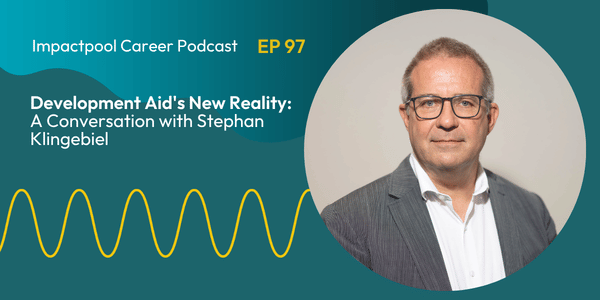
Listen on Apple Podcasts
Beyond the funding cuts
The numbers alone tell a dramatic story. In 2025, US official development assistance fell by 57%, a striking figure given that the US has long been by far the largest ODA donor. Germany, France, the UK, and Japan cut funding too, meaning the retreat isn't only American.
But Klingebiel argues the deeper shift is happening elsewhere. Beyond funding and the dismantling of institutions like USAID, the US administration is actively pushing back against the language and norms that have underpinned development cooperation for years. Terms like Agenda 2030, the SDGs, gender, and climate change are disappearing from documents like the latest G7 development communique. "This is not just about words," Klingebiel says, "but about our beliefs about what we want to achieve."
Who fills the gap?
No single actor is stepping in to replace US leadership, Klingebiel notes. China continues its own South-South cooperation and Belt and Road approach, but is shifting toward higher-income countries and explicitly avoids framing itself as a replacement for the US. Meanwhile, countries across the Global South increasingly have choices: India, Gulf states, Turkey, and others are all expanding their presence. The result is what Klingebiel calls "multi-alignment" rather than a single new leader.
A fragmenting future for the SDGs
Asked whether a meaningful post-2030 development framework is realistic, Klingebiel expects any successor to be less universal, less binding, and more modular than Agenda 2030, a patchwork of coalitions agreeing on different pieces rather than one shared global package.
The autocracy factor
One underappreciated trend: by the end of 2025, autocracies outnumbered democracies globally (92 to 87). Klingebiel warns this complicates assumptions in global governance forums like the UN General Assembly, where Global South representatives are often assumed to act in their populations' interest. Transactional, self-enriching leadership, echoed, he notes, in the Trump administration's own dealings, undermines that assumption on both sides.
What this means for careers in the sector
For people working in or aspiring to join international organizations, Klingebiel expects continued funding volatility, more institutional mergers and contraction (pointing to the UN80 reform process), and a job reality increasingly shaped by geopolitics rather than pure development impact. Humanitarian funding met only 25% of needs last year, the lowest ever.
Signals worth watching
Klingebiel offers three things to track: the language used in major communiques (a shrinking space for open discussion), the "hijacking" of development institutions for geopolitical rather than developmental ends, and, more hopefully, "pockets of effectiveness," where middle powers and like-minded coalitions still manage to achieve concrete wins, as seen at last year's Seville Finance for Development summit.
 His closing note is one of qualified optimism: even amid the bigger disruptions, individual governments and institutions still retain real choices about what they fund, what they sign, and who they align with.
Listen to the full episode of the Impactpool Podcast for the complete conversation.