
Listen on Apple Podcasts
Fifteen Years, Six Contexts
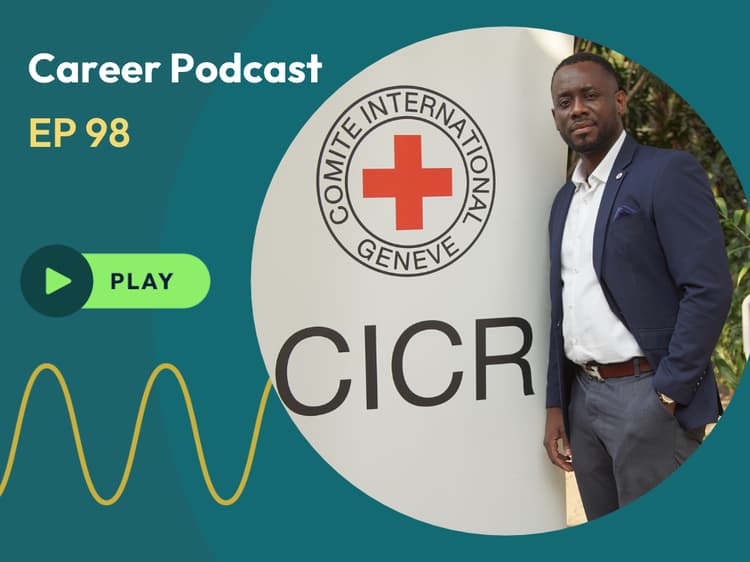
Stéphane joined the ICRC in 2011 in Côte d'Ivoire, covering eight countries from the regional delegation. Since then, he has supported the Yemen response from Djibouti, opened a new delegation in Burkina Faso, worked in Sudan at the start of the latest conflict, and supported teams in Gaza and Jerusalem. He is now back in the DRC, after his first mission there 3 years ago.
Hiring for Emotional Readiness
In a crisis setting, technical skills alone are not enough. The ICRC uses behavioural interviews, asking, for instance, how a candidate made a critical decision under pressure, and scenario-based assessments built on realistic field dilemmas. Questions on cultural sensitivity and managing one's own stress complete the picture.
Is there a common weak spot? Not really, says Stéphane. People who have lived through these situations simply find it easier to talk about them.
The Myths That Keep People From Applying
These assumptions are often exactly what stops people from applying, so Merlijn asked Stéphane to take them on directly. He has heard plenty.
-
You need to be a doctor or a nurse. The ICRC equally depends on logistics, engineering, law, finance and HR.
-
It's a religious organisation. The Red Cross emblem suggests so to some. It is not.
-
Field workers are always on the front line. Much of the work is behind the scenes: logistics, administration, information management.
-
You will see quick results. Systemic problems take time, which is why patience is a trait worth recruiting for.
Beyond Resilience: Structures That Prevent Burnout
Humanitarian work is meaningful but also physically and emotionally taxing. During COVID-19, many colleagues were stuck in their duty stations for months. What helps, beyond telling people to be resilient:
-
Access to mental health professionals, in-house or external
-
Peer support and buddy systems
-
Teleworking, flexible schedules and mandatory rest periods
-
Stress management training for staff and managers
-
Open communication, feedback and recognition, which "sometimes we forget"
At the ICRC, staff health managers report to the country HR manager, which is where Stéphane feels he makes the biggest difference. "It can be small for the others, but it can be very important for our staff."
Empathy, Trust and Multicultural Teams
Empathy comes up again and again in this conversation, and Stéphane makes no apology for it. In unpredictable, high-stress settings, it means understanding what a team really needs, communicating clearly but with sensitivity, and listening without interrupting or judging. Emotional intelligence can be learned, and the ICRC trains for it.
In multicultural teams, cultural briefings, cross-cultural training and transparent communication build trust. As Merlijn, our podcast host, adds, empathy is not softness: being kind also means being clear.
Getting In, and Staying In
Stéphane was once told nobody lasts more than two years in humanitarian work. Fifteen years later, he is still here, and the ICRC's principles of neutrality and independence travel with you wherever you go next.
His advice is to build skills rather than fixate on one employer: digital literacy and data, cybersecurity, public health, finance, humanitarian law, and mental health support.
No field experience yet? Start with an internship. He recalls an HR intern in Burkina Faso who began by logging recruitment data and was later hired by the ICRC. "At the end of the day, it's a win-win experience."
Duration, or Donation
What keeps him going? A line a colleague once shared, attributed to Myles Munroe: the value of life is not in its duration, but in its donation. What counts is not how long you have been in the sector, but how well you respond to the needs in front of you.
For anyone still hesitating: 'field work' is not reserved for doctors, and it is not a lifetime on the front line. It needs people with skills, patience and empathy who are willing to start somewhere.
Listen to the full episode on the Impactpool Career Podcast.